解晓雯
解晓雯 Ph.D,
北京大学药学院研究员,博士生导师
地址:北京市海淀区学院路38号医学科技楼
邮编:100191
Xiaowen Xie, Ph.D.
Researcher, PhD Supervisor, School of Pharmaceutical Sciences, Peking University
Address: Medical Science and Technology Building, No. 38 Xueyuan Road, Haidian District, Beijing
Postcode: 100191

01 / Principal Investigator

实验室管理员:钟美金Lab Manager: Meijin Zhong

解晓雯博士,北京大学药学院化学生物学系研究员,博士生导师,北京大学博雅青年学者,天然药物及仿生药物全国重点实验室研究员,国家高层次海外人才。解晓雯博士本科毕业于吉林大学生物与农业工程学院,博士毕业于北京大学前沿交叉学科研究院,随后分别在美国德州西南医学中心和华盛顿大学进行博士后训练,于2025年10月正式入职北京大学药学院。Dr. Xiaowen Xie is a Principal Investigator and doctoral supervisor in the Department of Chemical Biology, School of Pharmaceutical Sciences, Peking University. She is also a Peking University Boya Young Scholar, a researcher at the State Key Laboratory of Natural and Biomimetic Drugs, and a recipient of China’s National High-level Overseas Talent Program. Dr. Xie received her bachelor’s degree from the College of Biological and Agricultural Engineering, Jilin University, and her Ph.D. from the Academy for Advanced Interdisciplinary Studies, Peking University. She subsequently completed postdoctoral training at UT Southwestern Medical Center and the University of Washington. In October 2025, she officially joined the School of Pharmaceutical Sciences, Peking University.

本课题组致力于利用蛋白组学分析降解组学分析深度突变扫描Cryo-EM等多学科交叉技术,专注于药物靶点发现和药物设计的基础研究。尤其关注E3连接酶识别底物的作用模式分子胶介导的「难成药靶点」蛋白水平调控的作用机制,及全新分子胶的发现研究。在拓展分子胶可靶向的E3连接酶靶向空间、揭示新型分子胶作用模式等方面取得系列成果。总计发表SCI论文9篇,其中近5年以第一作者(含共同)及通讯作者,发表高水平论文3篇,包括Nature 论文2篇等。研究成果被同期 Nature、Nature Reviews Drug Discovery、Molecular Cell、Cancer Discovery等杂志专题报道及评述。The group integrates proteomics, degradomics, deep mutational scanning, Cryo-EM, and other interdisciplinary approaches to study drug target discovery and mechanism-driven drug design. We focus on how E3 ligases recognize substrates, how molecular glues regulate traditionally difficult-to-drug targets at the protein level, and the discovery of new molecular glues. The group has made a series of advances in expanding the E3 ligase target space accessible to molecular glues and revealing new modes of molecular glue action. Dr. Xie has published 9 SCI-indexed papers, including 3 high-impact papers in the past five years as first author (including co-first author) and corresponding author, with 2 papers in Nature. These studies have been highlighted or reviewed by Nature, Nature Reviews Drug Discovery, Molecular Cell, Cancer Discovery, and other journals.
近5年代表性研究成果Representative Research from the Past Five Years

  • Rusnac, D., Zheng, N., Xie, X.*, 2025. Versatile Roles of Inositol Hexakisphosphate in the Ubiquitin-Proteasome System. Essays in Biochemistry, (2026):69(05), p.EBC20253032.Rusnac, D., Zheng, N., Xie, X.*, 2025. Versatile Roles of Inositol Hexakisphosphate in the Ubiquitin-Proteasome System. Essays in Biochemistry, (2026):69(05), p.EBC20253032.
  • Xie, X.#, Zhang, O.#, Yeo, M.#, et al. "Converging mechanism of UM171 and KBTBD4 neomorphic cancer mutations." Nature (2025): 241-249.Xie, X.#, Zhang, O.#, Yeo, M.#, et al. "Converging mechanism of UM171 and KBTBD4 neomorphic cancer mutations." Nature (2025): 241-249.
  • Yeo, M.#, Zhang, O.#, Xie, X.#, et al. "UM171 glues asymmetric CRL3–HDAC1/2 assembly to degrade CoREST corepressors." Nature (2025): 232-240.Yeo, M.#, Zhang, O.#, Xie, X.#, et al. "UM171 glues asymmetric CRL3–HDAC1/2 assembly to degrade CoREST corepressors." Nature (2025): 232-240.
  • Xie, P., Xie, X., Ye, C., Dean, K. M., Laothamatas, I., Taufique, S. T., ... & Liu, Y. Mammalian circadian clock proteins form dynamic interacting microbodies distinct from phase separation. Proceedings of the National Academy of Sciences, (2023): e2318274120.Xie, P., Xie, X., Ye, C., Dean, K. M., Laothamatas, I., Taufique, S. T., ... & Liu, Y. Mammalian circadian clock proteins form dynamic interacting microbodies distinct from phase separation. Proceedings of the National Academy of Sciences, (2023): e2318274120.
* 通讯作者* Corresponding author # 共同第一作者# Co-first authors
  1. 分子胶Molecular Glues
  2. E3识别机制E3 Recognition Mechanisms
  3. 靶点发现与可成药性评估Target Discovery and Druggability Assessment

03 / Evidence

实验室过往的发现Selected Discoveries

UM171 molecular glue discovery

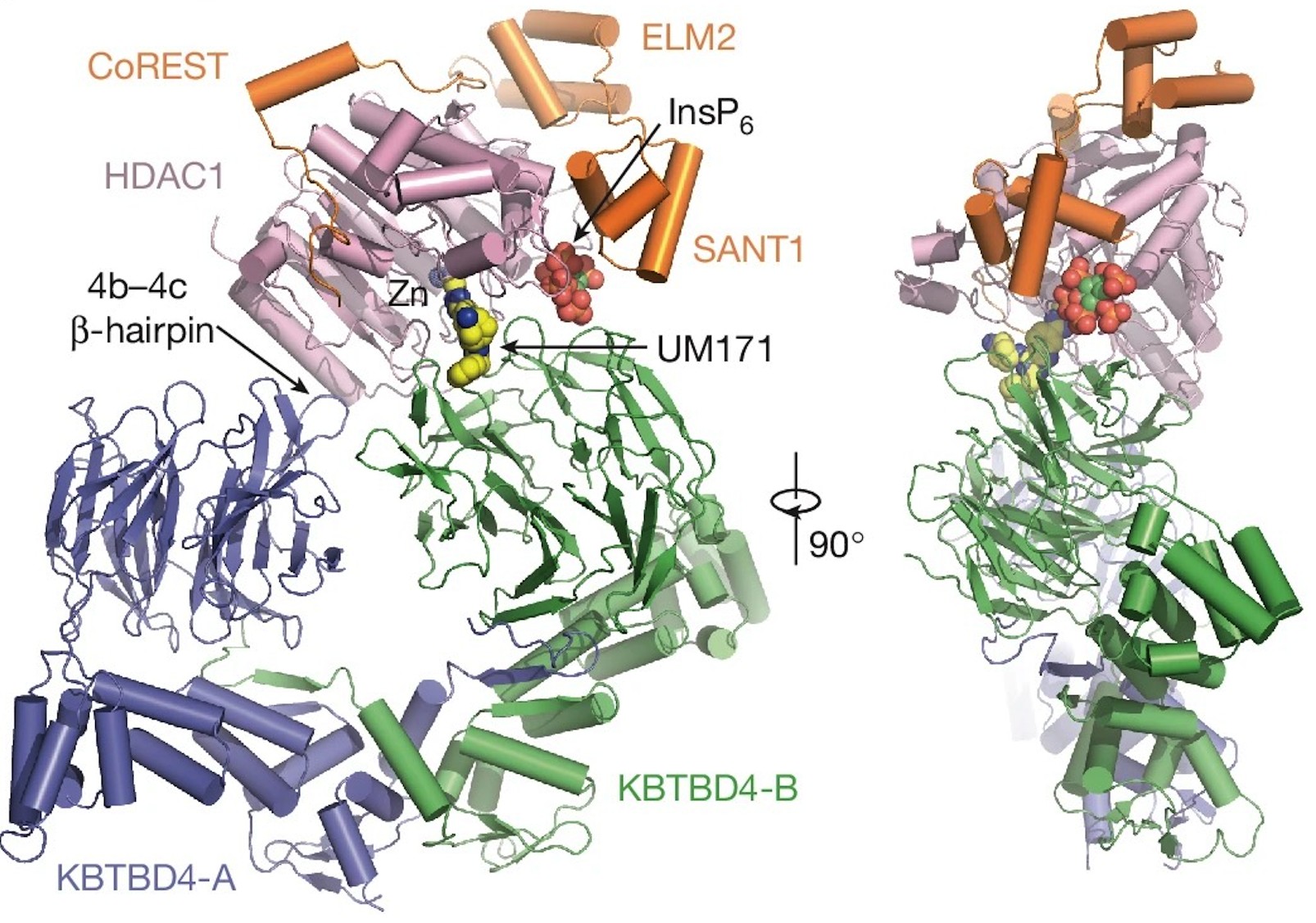
UM171 作为分子胶诱导 CRL3KBTBD4–HDAC1/2 非对称组装并降解 CoRESTUM171 glues asymmetric CRL3–HDAC1/2 assembly to degrade CoREST

拓展分子胶可靶向的E3连接酶空间:UM171 作为分子胶促进CRL3KBTBD4与HDAC1/2 相互作用,从而有效降解与HDAC1/2相作用的 CoREST 转录抑制复合体;打破了以往仅有CRBN、VHL等少有的几个E3连接酶可用的局限。Expanding the E3 ligase space targetable by molecular glues: UM171 promotes CRL3KBTBD4 interactions with HDAC1/2, leading to effective degradation of the CoREST transcriptional corepressor complex. This breaks the previous limitation that only a few E3 ligases (CRBN, VHL, etc.) were accessible.

Nature (2025a) · UM171 诱导 CRL3KBTBD4–HDAC1/2 非对称组装并降解 CoREST
DOI: 10.1038/s41586-024-08532-4
Nature (2025a) · UM171 glues asymmetric CRL3KBTBD4–HDAC1/2 assembly to degrade CoREST corepressors
DOI: 10.1038/s41586-024-08532-4
KBTBD4 neomorphic mutations mechanism

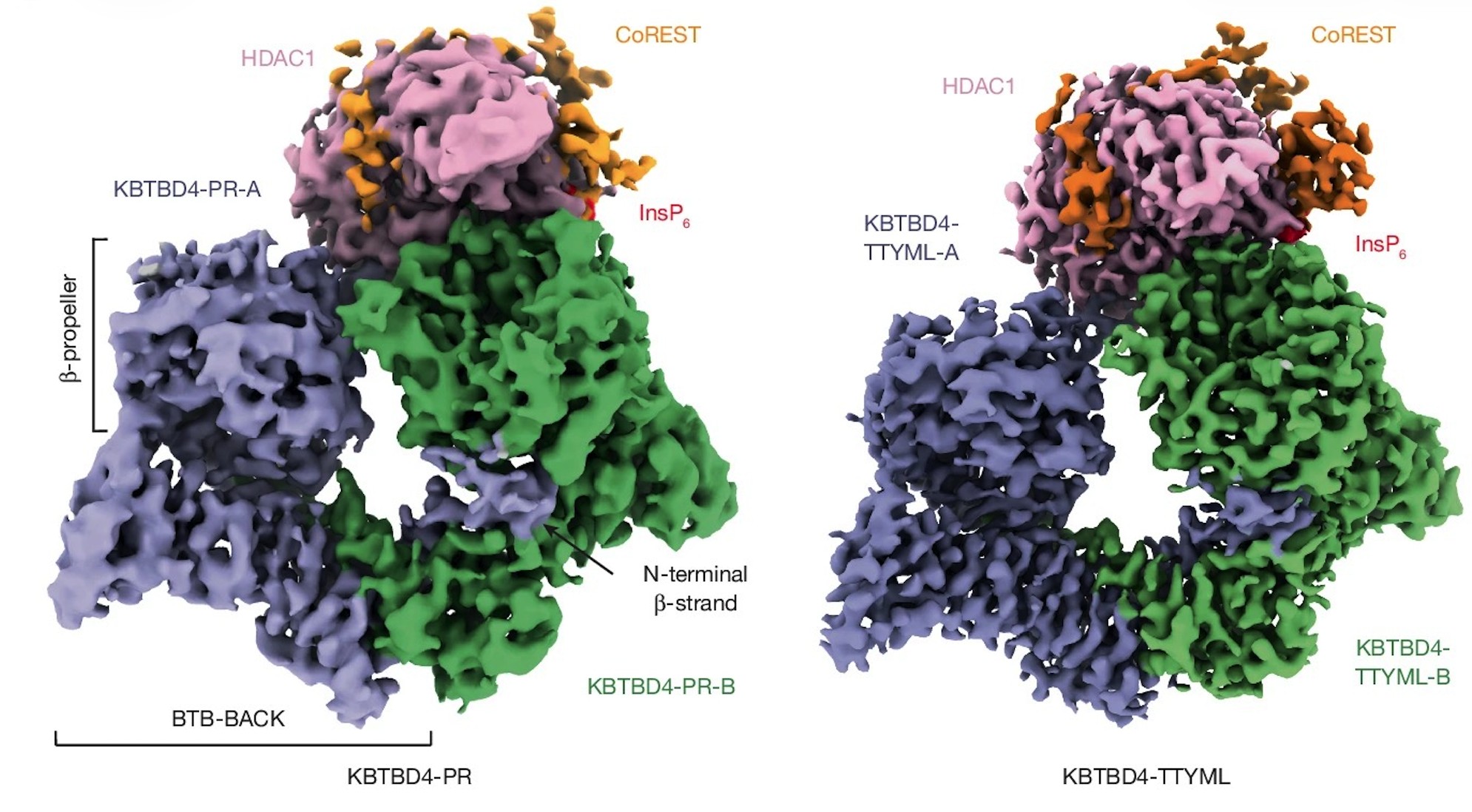
KBTBD4 肿瘤突变与 UM171 的”趋同”机制:KBTBD4肿瘤突变诱导其与 HDAC1/2 的新生互作并异常降解CoRESTConverging mechanism of UM171 and KBTBD4 neomorphic cancer mutations through HDAC1/2-mediated neo-interactions

创新性发现并命名"遗传分子胶":KBTBD4 肿瘤热点突变产生新的蛋白互作界面,直接招募 HDAC1/2并降解CoREST,机制上与 UM171 趋同;遗传分子胶与化学分子胶趋同机制的发现,开辟了发现化学分子胶的全新途径。A pioneering discovery and naming of "genetic molecular glue": cancer hotspot mutations in KBTBD4 create a neomorphic protein interaction interface that directly recruits HDAC1/2 and degrades CoREST, converging mechanistically with UM171. The discovery of convergent mechanisms between genetic and chemical molecular glues opens an entirely new path for discovering chemical molecular glues.

Nature (2025b) · UM171 与 KBTBD4 新生肿瘤突变的趋同机制
DOI: 10.1038/s41586-024-08533-3
Nature (2025b) · Converging mechanism of UM171 and KBTBD4 neomorphic cancer mutations
DOI: 10.1038/s41586-024-08533-3

04 / Team